
Teardowns, removals and clean lots
Demolition Contractors in Seattle, WA
House, garage, concrete and interior demolition, with the permits, asbestos notice and sewer cap handled in the right order.
- Free walkthrough and an itemized written estimate
- Permit, asbestos notice and side sewer steps planned before work starts
- Debris sorted for salvage and recycling, not just dumped
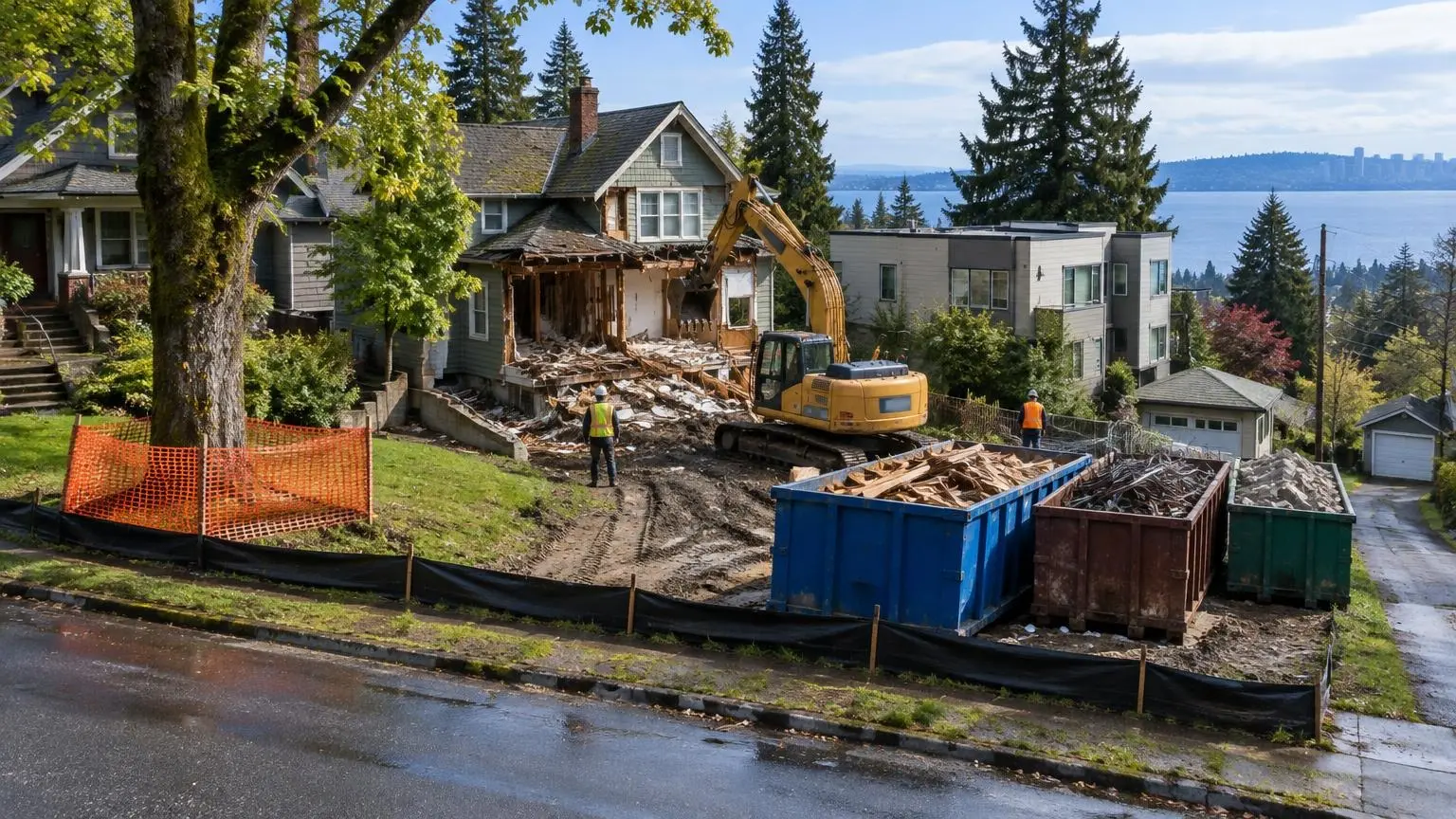
Demolition in Seattle Starts With Paperwork
Elite Demolition Contractors Seattle tears down houses, detached garages, sheds, concrete slabs, interiors and small commercial buildings across Seattle, Washington. Good demolition contractors in Seattle spend as much time on the sequence as on the machine work, because the city, the clean air agency and the utilities each have a step that has to be finished before the next one can start. Miss one and the job stops. Our job is to line those steps up, take the structure down safely, sort what comes out of it, and leave you a clean, graded lot ready for whatever is next.
What a Seattle teardown requires
SDCI says plainly that you need a demolition permit to remove a building, and each permit covers one building. A house and a detached garage on the same lot are two applications unless the garage comes down as part of a larger project. Before the permit is issued, the application has to show or include:
- A salvage assessment, required for every project that includes demolition
- Rat abatement: a licensed pest control company working the site for at least 15 days immediately before demolition starts, confirmed on SDCI's declaration form
- An asbestos survey, done by a certified inspector, before the demolition permit issues
- A site plan showing what will be removed and every existing tree with its protection
- A construction stormwater and soil plan, with a pre-approved standard plan for small sites under 5,000 square feet of footprint and disturbance
SDCI's posted targets give a sense of timing: intake usually two to three weeks after a complete application is uploaded, initial review two to three weeks after intake fees are paid, about four weeks for each round of corrections, and about a week for final review. Once issued, the permit is good for 18 months.
The 10-day asbestos clock
The Puget Sound Clean Air Agency covers Seattle and requires an asbestos survey by an AHERA-certified building inspector before any demolition. The owner, or the owner's agent, then files an Asbestos/Demolition Notification with a fee. The agency is clear that this applies whether or not any asbestos is found, to any structure with more than 120 square feet of roof area. After filing, you must wait 10 days before the structure comes down. Any friable asbestos has to be removed before demolition. We build that 10-day window into the schedule from the first meeting so it never becomes the thing that holds a crew off the site.
Lead paint matters too. Per Point2Homes' summary of Census data, about 53 percent of Seattle's housing was built before 1980, and nearly 23 percent in 1939 or earlier. Under the EPA's Renovation, Repair and Painting rule, work that disturbs paint in homes built before 1978 is done by certified firms using lead-safe practices.
Shutoffs and the side sewer
SDCI's demolition next-steps sheet lists the disconnects that come before any tear-down: Seattle Public Utilities and Seattle City Light at (206) 684-3000, Puget Sound Energy for gas at 1-888-321-7779, and any cable, phone or steam provider serving the building. The side sewer is capped under its own side sewer permit from the Drainage and Sewer Review Desk. Before digging out footings or a basement, the public underground lines get marked through 811. We track each of these on one list so you can see what is done and what is pending.
Ground, slopes and trees
Seattle sits on hills between Puget Sound and Lake Washington, and plenty of lots are steep. SDCI may ask for a topographic survey and a geotechnical report on steep slope, known slide or peat settlement areas, and it requires a pre-application site visit if a project will disturb more than 750 square feet or any land on a site with an environmentally critical area. Trees are protected too. Under the city's tree code, a tree's protection area is figured at one foot of radius for each inch of trunk diameter, and removing a tree 6 inches or larger requires public notice posted at least six full business days ahead. On a tight Seattle lot, that can decide where the excavator sits and how the house comes apart.
Where the debris goes
Seattle expects demolition debris to be recovered, not just landfilled. After a project larger than 750 square feet, a waste diversion report goes to Seattle Public Utilities within 60 days of final inspection, listing each material, its quantity, the hauler and where it ended up. We plan for that before work starts: lumber, fixtures and cabinets pulled for salvage where they are worth saving, metal and clean wood sent to recyclers, and concrete broken up and hauled for crushing. If you want to save more of the house, deconstruction is an option, and SDCI notes a deconstruction permit can sometimes be issued before the building permit.
Six kinds of work
- House demolition: full teardowns, foundation and basement removal, backfill and grading.
- Interior demolition: kitchens, baths, basements and non-structural walls taken back to studs.
- Concrete removal: driveways, patios, walks, slabs, steps and footings broken out and hauled.
- Garage and shed removal: detached garages, carports, sheds and their slabs.
- Deconstruction and salvage: careful take-down that keeps lumber and fixtures for reuse.
- Commercial demolition: tenant improvement strip-outs and small commercial buildings.
Call (425) 598-0539 or send the form, and we will set up a time to walk the property.
Common Questions
What do demolition contractors do?
A demolition contractor takes down all or part of a structure and removes the debris. In Seattle that also means coordinating the asbestos survey and notice, utility shutoffs, the side sewer cap, permits, tree protection and erosion control, then hauling and sorting the material and grading the site. The machine work is often the shortest part of the job.
Do I need a permit to demolish a house in Seattle?
Yes. SDCI requires a demolition permit to remove a building, one permit per building. Exemptions include a one-story accessory structure under 120 square feet of roof area on pier blocks or a slab, and interior soft demolition during a remodel, which falls under the construction permit.
How long does it take to get a demolition permit in Seattle?
SDCI's own targets are two to three weeks for intake after a complete application, two to three weeks for initial review, about four weeks per correction cycle and about a week for final review. Add the 15 days of rat abatement and the 10-day asbestos notice, which can run alongside review if planned early.
Do I need an asbestos survey if my house has no asbestos?
Yes. The Puget Sound Clean Air Agency requires a survey by an AHERA-certified inspector and an Asbestos/Demolition Notification for any structure over 120 square feet of roof area, whether or not asbestos is found. Demolition can start 10 days after the notice is filed.
What does house demolition cost?
Fixr's national guide lists $5 to $10 per square foot for mechanical demolition, or $7,500 to $15,000 for a 1,500-square-foot house on a slab. Basements, asbestos, steep access and hauling distance push it higher. Our written estimate after the walkthrough is the price.
Can a small or residential demolition contractor in Seattle handle a garage or shed?
Yes, and many of our jobs are that size. A one-story shed under 120 square feet of roof on pier blocks or a slab does not need an SDCI demolition permit, while a larger detached garage usually does unless it comes down as part of a bigger project. We check which applies before pricing.
Can I demolish a rental house in Seattle?
SDCI allows housing demolition only when the building meets one of its criteria, such as being owner occupied, not used as a rental within the last six months, or having a permit already issued for the new building. Tenant relocation rules apply if there are tenants. We point you to SDCI to confirm which criterion fits.
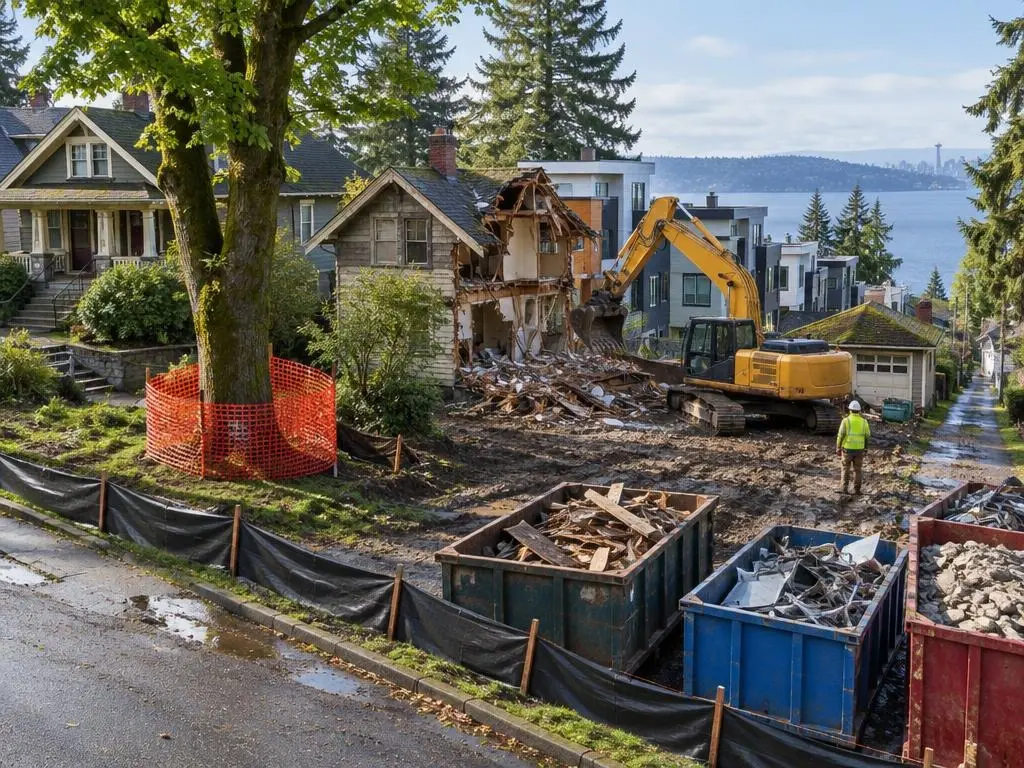
Our Demolition Services
Whole-house teardowns, interiors, concrete, outbuildings, salvage-first deconstruction and commercial strip-outs, each planned around Seattle's permit and waste rules.
House Demolition
Full teardowns of Seattle houses, including basements and foundations, with the asbestos notice, shutoffs and sewer cap handled first.
Learn more →Interior Demolition
Kitchens, baths, basements and non-structural walls taken back to studs, with dust control and debris hauled out.
Learn more →Concrete Removal
Driveways, patios, walks, slabs, steps, footings and old retaining walls broken out and hauled for recycling.
Learn more →Garage & Shed Removal
Detached garages, carports, sheds and their slabs taken down and hauled away, with the permit question answered up front.
Learn more →Deconstruction & Salvage
Houses and outbuildings taken apart by hand and machine so lumber, fixtures and materials can be reused instead of landfilled.
Learn more →Commercial Demolition
Tenant improvement strip-outs and small commercial buildings, scheduled around business hours, building rules and the city's permit steps.
Learn more →Where We Work
Most of our work is inside Seattle itself, from the older neighborhoods on Capitol Hill, Queen Anne, Beacon Hill and West Seattle to the lots north of the Ship Canal. We also take jobs in the larger cities around it: Bellevue, Kirkland and Redmond across Lake Washington, Shoreline and Lynnwood to the north, and Renton, Burien, Kent and Federal Way to the south. Each of those cities runs its own permit counter with its own forms, so the paperwork changes when you cross a city line even though the Puget Sound Clean Air Agency's asbestos notice and 10-day wait apply across King County. Our town pages note what we found about local housing and rules. Wherever the property is, we confirm the permit steps for that address before we price the job.
- Demolition Contractors in Seattle, WA
- Demolition Contractors in Bellevue, WA
- Demolition Contractors in Redmond, WA
- Demolition Contractors in Kirkland, WA
- Demolition Contractors in Renton, WA
- Demolition Contractors in Kent, WA
- Demolition Contractors in Federal Way, WA
- Demolition Contractors in Shoreline, WA
- Demolition Contractors in Burien, WA
- Demolition Contractors in Lynnwood, WA
- Demolition Contractors in Edmonds, WA
- Demolition Contractors in Bothell, WA
- Demolition Contractors in Sammamish, WA
- Demolition Contractors in Issaquah, WA
- Demolition Contractors in Auburn, WA
- Demolition Contractors in Mercer Island, WA
- Demolition Contractors in Tukwila, WA
- Demolition Contractors in SeaTac, WA
- Demolition Contractors in Des Moines, WA
- Demolition Contractors in Mountlake Terrace, WA
- Demolition Contractors in Lake Forest Park, WA
- Demolition Contractors in Kenmore, WA
- Demolition Contractors in Woodinville, WA
- Demolition Contractors in Newcastle, WA
- Demolition Contractors in Mukilteo, WA
- Demolition Contractors in Everett, WA
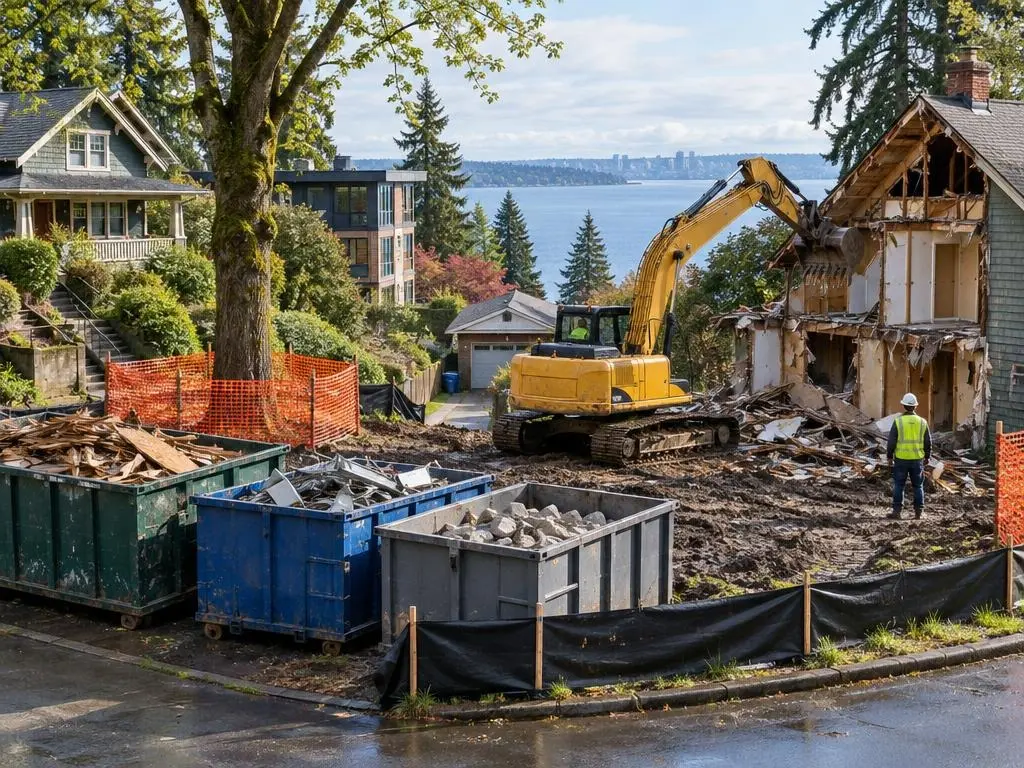
Why Homeowners Call Elite Demolition Contractors Seattle
Steps in the right order
Survey, 10-day asbestos notice, utility shutoffs, sewer cap and permit lined up on one schedule.
Itemized estimates
Tear-down, hauling, foundation, slab and abatement priced on separate lines.
Debris sorted
Salvage pulled and wood, metal and concrete sent to recyclers, with records for the city's diversion report.
Lots left ready
Footings removed to the agreed depth, backfilled, graded and protected from runoff.
Get a Demolition Contractors Estimate
Free walkthrough and written estimate for demolition anywhere in Seattle and the nearby King County cities.